That record is your dog's baseline. It turns “something seems off” into something you and your vet can measure.
What is a baseline for my dog?
Your dog's individualized baseline is a record of what's normal for your dog, taken when they're healthy.
A normal range tells you what's normal for dogs. A individualized baseline tells you what's normal for your dog. Ranges in books are wide because they cover every breed, size, and age. Your dog can drift a long way inside that range and still look “normal” on paper. An individualized baseline catches the drift.
When should I start building my dog's baseline?
Start now, while your dog feels good. You can't compare today to a normal you never wrote down. A few days of notes is a start. About two weeks gives you the real pattern, because one good or bad day can fool you.
For older dogs, the American Animal Hospital Association recommends that dogs over 7 see their vet every six months [1]. Bring your notes. They add months of home information to a short exam window.
What is a normal breathing rate for a sleeping dog?
For most healthy adult dogs, it's well under 30 breaths per minute. In a study of 114 healthy dogs, the average sleeping rate was 13 breaths per minute, and no dog averaged more than 23 [2].
To measure it, wait until your dog is in a deep, calm sleep, not dreaming or twitching. Count each chest rise for 30 seconds, then double it. Repeat on three calm nights and average them.
Faster breathing at rest can come from pain, heart disease, or lung problems. A rise that sticks for several days is worth a call to your vet. Breathing that looks like hard work, or gums turning pale or blue, means go now.
How do I check my dog's weight and muscle at home?
Once a month, check three things: weight, body shape, and muscle. Judge fat and muscle separately: fat can hide muscle loss, even in an overweight dog [3,4].
Weight. Weigh yourself holding your dog, then subtract your own weight. Or drop by your vets office and just use their scale. A fear free visit is good for your dog. Grab a treat too, why not?
Body shape. At a healthy weight, you can easily feel the ribs, spine, and hips under a slight layer of fat. From above, you see a waist. From the side, the belly tucks up [4]. Bones visible from across the room suggest too thin. Hard-to-feel ribs, fat over the back and tail base, or no waist suggest extra weight [4].
Muscle. Feel five spots: the top of the head, the shoulder blades, both sides of the spine, the hip bones, and the thighs. The muscles along the spine are often the first place muscle loss shows [5]. Then try the press test. Over the spine and hips, how hard do you have to press to feel bone?
- Normal: you can't feel bone, even pressing firmly.
- Mild loss: you feel bone with light pressure.
- Moderate loss: you feel bone without pressing.
- Severe loss: you can see the bones [5].
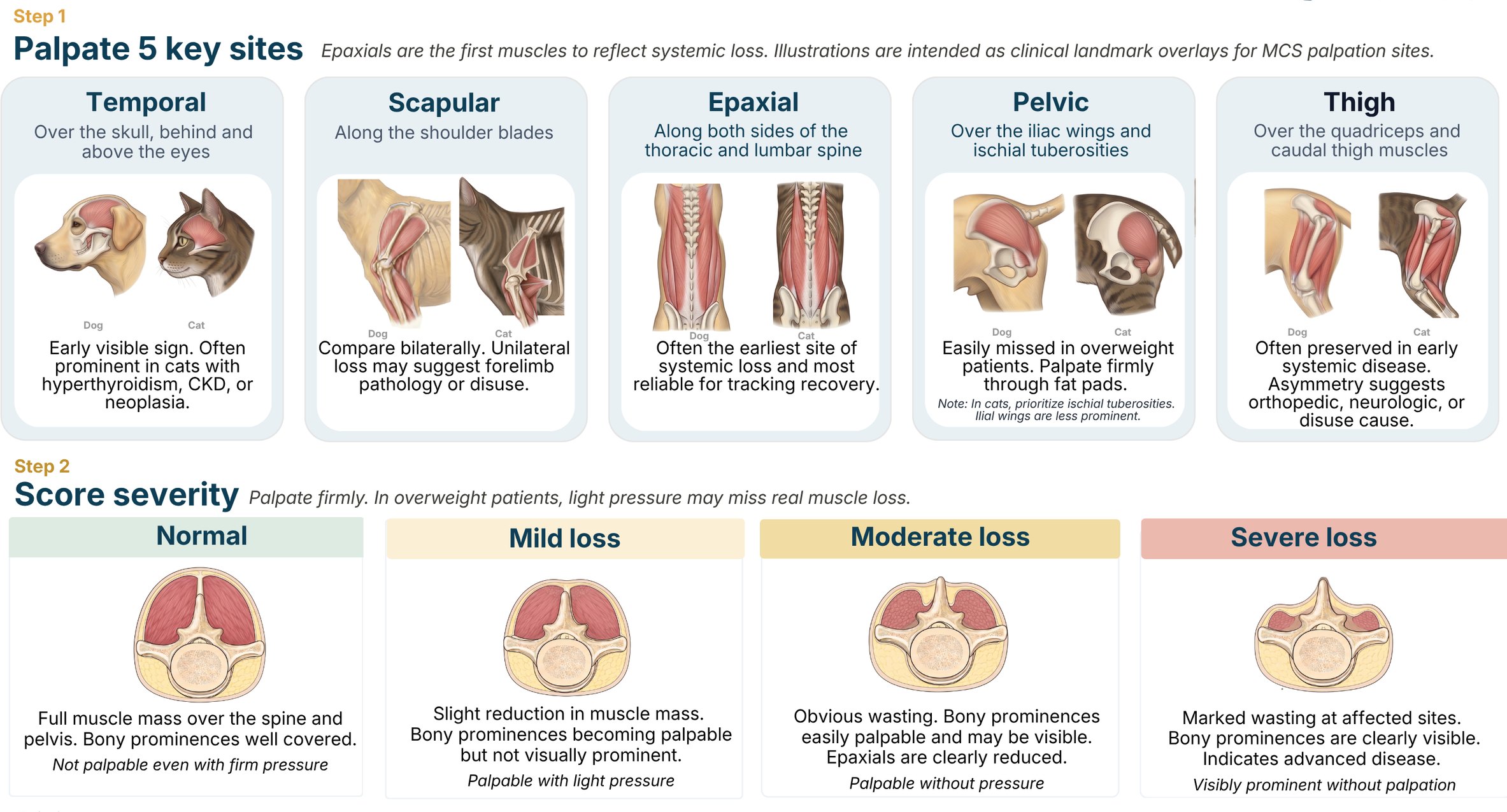
Write down the worst spot. Then compare left and right at the shoulders and thighs. If one side is smaller, your dog may be sparing that leg because of pain, a nerve problem, or less use [5]. Tell your vet, even if you haven't seen a limp.
Which everyday moves should I track?
Pick three to five benchmark moves: everyday activities that use your dog's whole body, like climbing the steps, jumping into the car, getting up from bed, or finishing the usual walk.
Once a week, rate each one: no problem, a little bit of a problem, quite a bit of a problem, a severe problem, or impossible. Vets use owner-chosen activities like these, called client-specific outcome measures, to track dogs with arthritis over time [6].
Does my dog's normal change with the time of day or the weather?
Yes, so compare like with like. Many dogs are stiffer in the morning, pant more on hot days, and sleep harder after a big hike. A Monday-morning get-up after a playful weekend shouldn't be compared to a Thursday afternoon when nothing has been happening. Measure at the same time of day and in the same calm state, and jot down the weather and what your dog did that day, as well as in the lead up.
Should I update my dog's baseline as they get older?
Yes, but slowly, and never throw away the first one. The risk is baseline creep: if you only ever compare to last week, a slow decline starts to feel normal, and you adopt each small step down as the new normal.
The fix is to keep your first healthy snapshot. Every few months, compare your dog to the version you wrote down when they felt their best. If the gap keeps widening, talk to your vet.
What should I write down?
A notes app or a card on the fridge works fine.
| What to record | How | How often |
|---|---|---|
| Sleeping breaths per minute | Count chest rises for 30 seconds during deep sleep, then double | 3 calm nights to start, then monthly |
| Weight and body shape | Weigh yourself holding your dog, then subtract; check ribs, spine, hips, waist, and tummy tuck | Monthly |
| Muscle | Press test at the 5 spots; note the worst spot and compare sides | Monthly |
| Benchmark moves | Rate 3 to 5 everyday moves from “no problem” to “impossible” | Weekly |
| Sounds and context | Groans, whimpers, or clicking joints; time, weather, and activity | Every entry |
How do I know if a change from my dog's baseline matters?
Ask three questions. Is it new? Is it lasting? Is more than one thing changing? A change that's new, sticks around, and shows up alongside another change deserves attention.
Then decide how fast to act:
- Wait and watch: one small change that goes away on its own.
- Call tomorrow: a change that lasts more than a few days, or two changes together, like faster breathing plus a benchmark move getting harder.
- Go now: your dog struggles to breathe, collapses, can't stand or put weight on a leg, or cries out in pain. Or if something just doesn’t feel right to you.
Can technology build my dog's baseline for me?
Yes and it can do the parts you can't do around the clock. The Ruff, Tether's collar-mounted device, spends its first two weeks learning your dog's normal, and continues all day every day It keeps learning, so it can tell a sudden change from a gradual drift without letting baseline creep hide either one. When something changes, it shows what changed with a simple signal: all clear, keep an eye on it, or talk to your vet. It doesn't diagnose, and it doesn't replace your vet. It learns about your dog so that you can too. It helps predict pain and provide you peace of mind.
“Every clinical claim The Ruff makes crosses my desk before it reaches you. I hold it to the standard I'd want for my own dogs, because that's exactly what yours deserve.”
Animals speak to those who listen.
Dr. Zachary L. Pollack, DVM, MRCVS
- American Animal Hospital Association. Supporting Your Senior Pet: Veterinary Care Recommendations. aaha.org.
- Rishniw M, Ljungvall I, Porciello F, Häggström J, Ohad DG. Sleeping respiratory rates in apparently healthy adult dogs. Res Vet Sci. 2012;93(2):965-969. doi:10.1016/j.rvsc.2011.12.014.
- Freeman L, Becvarova I, Cave N, et al. WSAVA Nutritional Assessment Guidelines. J Small Anim Pract. 2011;52(7):385-396. doi:10.1111/j.1748-5827.2011.01079.x.
- American Animal Hospital Association. Canine Body and Muscle Condition Score [chart]. AAHA; 2019.
- World Pet Obesity Association. Muscle Condition Score (MCS) [chart]. worldpetobesity.org; 2026. Adapted from the WSAVA Muscle Condition Score chart for dogs and Freeman LM. Cachexia and sarcopenia in dogs and cats. J Vet Intern Med. 2012;26(1):3-17.
- Gingerich DA, Strobel JD. Use of client-specific outcome measures to assess treatment effects in geriatric, arthritic dogs: controlled clinical evaluation of a nutraceutical. Vet Ther. 2003;4(1):56-66.